
November 4, 2026 · Troy Baker, Buyers Agent.
The last time Australian interest rates peaked and turned, Melbourne was the first major market to move. If history gives us any clue about the next phase of the cycle, that is the city I would be watching.
On 3 November the RBA lifted the cash rate to the highest it has been since late 2008. Plenty of investors are nervous, and I understand why. So I went back to the last time rates sat at these levels to see what actually happened next.
The short version: the city you bought in mattered far more than the headlines.
What happened after rates peaked in 2008
Every major capital was higher seven years later, but the results were miles apart. The cash rate peaked at 7.25% in 2008, then fell to 3.00% by April 2009 as the global financial crisis hit.
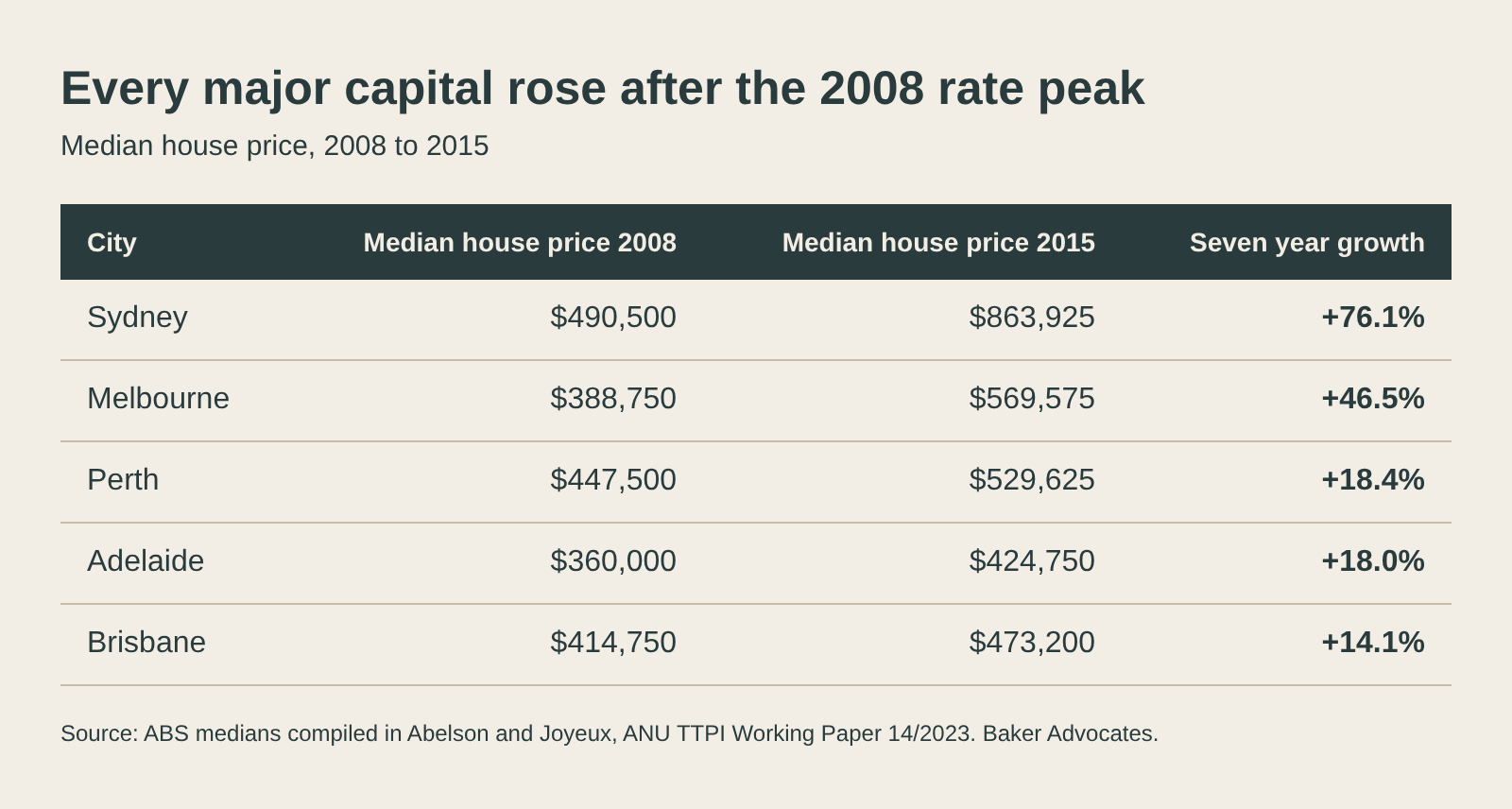
Sydney finished on top, but that is only half the story. More than half of its dollar gain came late, in 2013 to 2015, when it rose 28.9%. The real question is who moved first.
Melbourne moved first
In the first full year after the peak, Melbourne's median house price rose more than twice as fast as Sydney's.
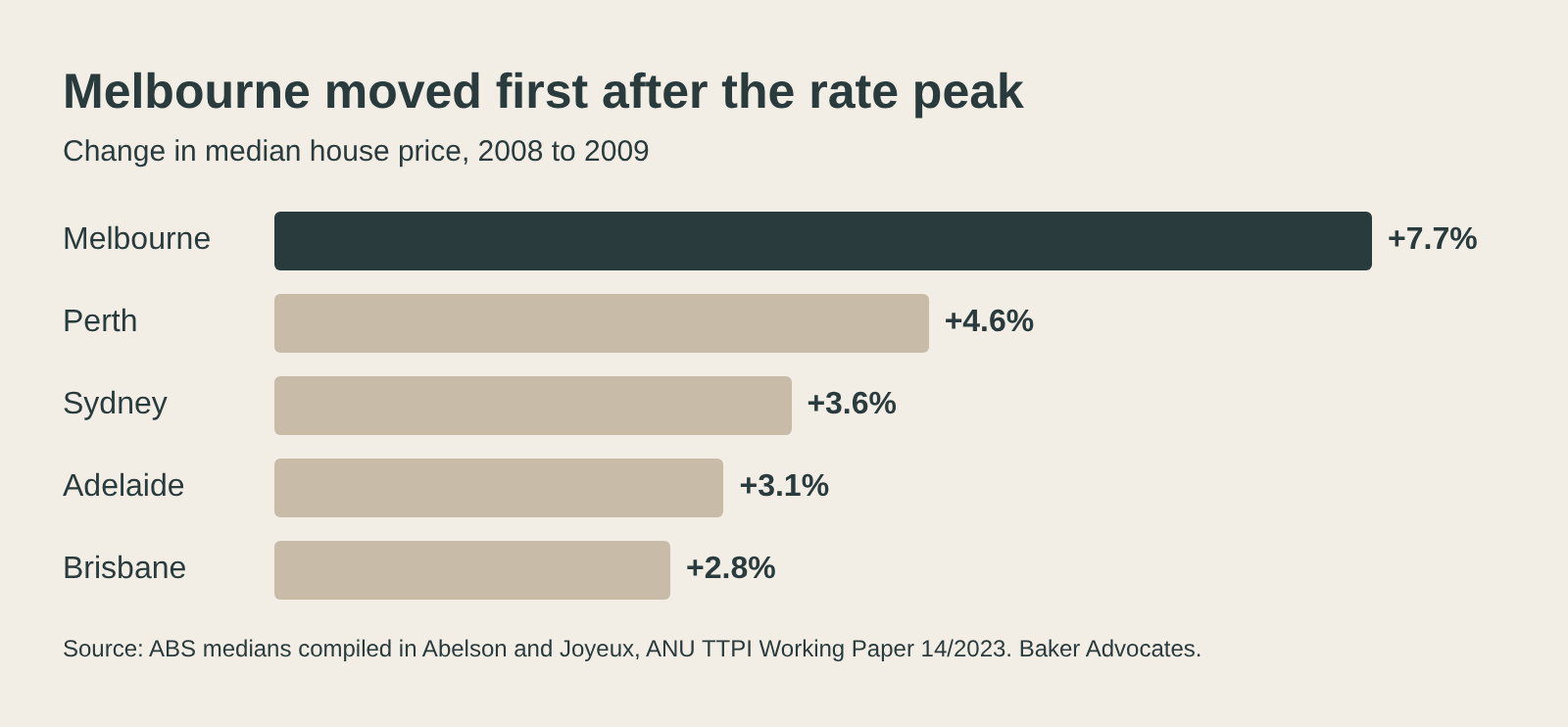
That lead then carried through. By 2010, Melbourne was up 27.1% on 2008, ahead of Sydney on 23.0% and well clear of Perth, Adelaide and Brisbane. Then the market paused, and Sydney took over from 2013.
Why Melbourne is worth watching now
Melbourne is still falling, but it is showing the earliest signs of steadying. Cotality's October figures have it down 0.8% for the month, the smallest fall of the five major capitals. Sydney fell 1.6%, Perth 1.7%, Adelaide 1.2% and Brisbane 2.0%.
Melbourne also went first on the way down. Its values peaked in November 2025, three months before Sydney's February 2026 peak, and were 7.2% below that high at September. Markets that correct first can also finish first, though that is a possibility and not a rule.
This is not a call that the bottom is in. Melbourne values are still 7.6% lower than a year ago, and one softer month is not a trend. It is simply where I would look first for the turn.
What the property cycle can and can't tell us
The 18.6 year property cycle is a useful lens, but it should only be used as an initial indicator not the only one... Eighteen years from 2008 lands right on 2026, which lines up. A few things to consider:
Rates are heading the other way. In 2008 the RBA was cutting hard into a crisis. Today it is raising rates to fight inflation, and we don't yet know where the peak is.
Rates were never the only driver. That period also had first home buyer stimulus and the mining boom, and both shaped which cities won.
Treat Melbourne as the market to watch, not a guaranteed winner.
What this means for you
Don't wait for the headlines to tell you the cycle has turned. By the time they do, the first leg can be gone. After 2008, Melbourne's strongest run came straight after the rate peak, while most people were still worried about the crisis.
But timing alone won't build wealth. A city can lead the cycle and still hold plenty of suburbs and properties you shouldn't buy. That's why our AssetIQ process assesses the location first, then the property, and starts with your goals. Every property has to earn its place in your plan, and we test it against higher rate scenarios before you commit.
Because the goal isn't more properties. It's more freedom.
Want to know whether your next move should wait or start now? Book an AssetIQ Strategy Call at bakeradvocates.com.au.
This article is general information only. It does not take your personal circumstances into account and is not financial advice. Past performance is not a guarantee of future results.